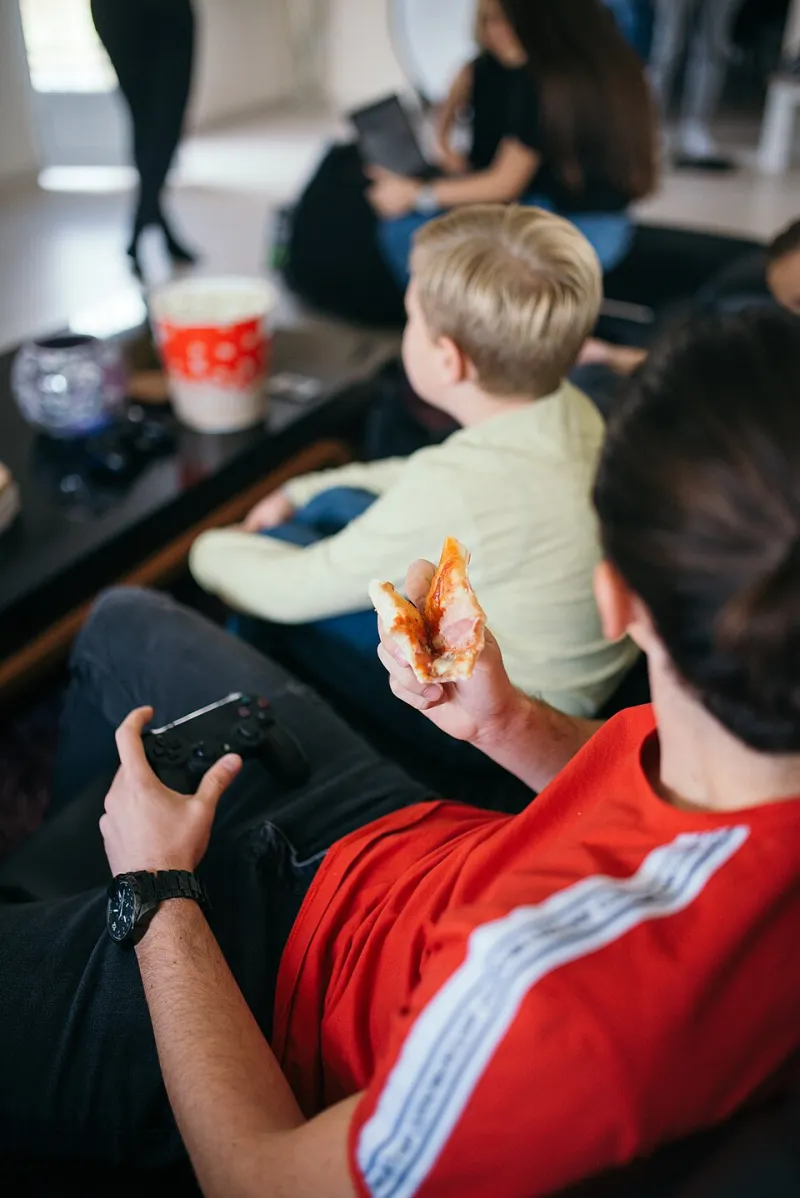
Press Start on Stress Relief: Why Gaming Is Becoming America's Favorite Mental Health Hack

Photo: U.S. Navy photo by Chief Operations Specialist Morris Lowery, Jr., Public domain, via Wikimedia Commons
It's 9:30 PM on a Tuesday. The inbox is a disaster, rent went up again, and the news cycle is doing what the news cycle does. You crack open your laptop, load up Stardew Valley, and spend the next 45 minutes watering crops and befriending a fictional blacksmith named Clint. By 10:15, your shoulders have dropped about three inches from your ears.
If that sounds familiar, you're not alone — and you're not wasting time. A growing body of research suggests that gaming, done intentionally, can be a genuinely effective tool for stress management and emotional regulation. For Millennials and Gen Z especially, two generations that grew up with controllers in their hands and burnout baked into their adult lives, it's less of a hobby and more of a coping mechanism. A healthy one, increasingly.
The Burnout Generation Needs a New Outlet
Let's be honest about the context here. Millennials entered the workforce during the Great Recession and spent the next decade being told to hustle harder. Gen Z followed them into a pandemic, a mental health crisis, and a job market that still hasn't fully figured itself out. According to the American Psychological Association's annual Stress in America survey, both generations consistently report higher stress levels than their older counterparts.
Traditional stress relief — exercise, meditation, journaling — works great in theory. But there's a reason "just go for a run" doesn't always land when you're mentally fried at 10 PM. Games offer something slightly different: active engagement that doesn't require you to be already calm to start. You can show up stressed and let the mechanics do some of the heavy lifting.
What the Research Actually Says
The science here is more nuanced than "games good, stress bad," but it's more supportive than you might expect.
A 2021 study published in the journal JMIR Mental Health found that casual video game play was associated with reduced cortisol levels — that's the stress hormone — in participants who played for moderate sessions after a stressful task. The key word is moderate: the stress-relief benefits tended to peak around 30–60 minutes and didn't necessarily compound with longer sessions.
Dr. Rachel Kowert, a research psychologist who has published extensively on gaming and mental health, has noted that games can serve as effective "detachment experiences" — a psychological concept describing activities that help people mentally disengage from work or stressors. "The immersive quality of games," she's explained in interviews, "gives the mind something specific to focus on, which interrupts the rumination cycle."
Rumination — the mental habit of replaying stressors over and over — is a significant contributor to anxiety and depression. Games, particularly ones that demand low-to-moderate cognitive engagement, can short-circuit that loop.
Not All Games Are Created Equal
Here's where it gets practical. The type of game matters enormously, and matching the game to your specific mental state is something players often figure out intuitively but rarely talk about explicitly.
For pure decompression: Cozy and simulation games are the gold standard. Stardew Valley, Animal Crossing: New Horizons, PowerWash Simulator (yes, really), and Unpacking consistently top community lists for stress relief. These games have low stakes, gentle pacing, and a satisfying sense of incremental progress. Psychologists point to the concept of "mastery experiences" — small, achievable wins — as a key mechanism here. Finishing a farm season or decorating a room gives your brain a hit of accomplishment without the pressure of real-world consequences.
For anxiety and mental restlessness: Puzzle games are surprisingly effective. Tetris, Monument Valley, and Mini Metro require just enough concentration to quiet anxious thoughts without overwhelming you. There's actually clinical research specifically on Tetris — multiple studies have found it can reduce intrusive thoughts and even PTSD-related flashbacks by occupying the brain's visuospatial processing resources. That's not marketing copy; that's peer-reviewed science.
For emotional processing: Narrative adventure games hit differently. Titles like Celeste, Spiritfarer, and What Remains of Edith Finch deal directly with themes of anxiety, grief, and identity in ways that many players describe as cathartic. "I ugly-cried through Spiritfarer and felt lighter for a week," is basically a genre review at this point. Story-driven games let players experience and process complex emotions in a safe, contained environment — something therapists call "narrative distance."
For social connection: Multiplayer casual games — think Among Us, Jackbox Party Pack, or even Fortnite with friends — address the loneliness component of stress, which is often underrated. Social gaming, particularly with existing friends over voice chat, can replicate the stress-relieving effects of in-person social interaction for people who don't always have easy access to it.
Real People, Real Results
Talk to gamers about this and the stories come quickly. Marcus, a 29-year-old nurse from Chicago, describes Minecraft as his "decompression chamber" after overnight shifts. "There's something about just building something with no stakes that resets my brain. I don't have to make any decisions that matter."
Jordan, 24, a grad student in Austin, found Celeste during a particularly rough semester. "The game is literally about a character dealing with anxiety and self-doubt. Playing through it felt like someone understood what I was going through. It wasn't escapism — it was more like company."
These aren't outliers. Reddit communities like r/CozyGames and r/patientgamers are full of threads where people openly discuss using specific games to manage depression, anxiety, and burnout. The conversation has shifted — gaming as self-care isn't a fringe idea anymore.
A Quick Guide to Gaming for Your Mental State
- Stressed and overwhelmed? → Reach for a cozy sim. Stardew Valley, Animal Crossing, or Disney Dreamlight Valley.
- Anxious and can't quiet your brain? → Try a puzzle game. Tetris Effect, Mini Metro, or Monument Valley.
- Emotionally heavy or processing something? → Narrative games. Celeste, Spiritfarer, Gris.
- Lonely or disconnected? → Social multiplayer. Jackbox, Phasmophobia with friends, It Takes Two.
- Just need to turn your brain off? → Idle or incremental games. Cookie Clicker, Idle Miner Tycoon.
Drop the Guilt, Keep the Controller
The "guilty pleasure" framing around gaming has always been a little suspect, but it's increasingly hard to justify. When a 45-minute session demonstrably lowers your stress hormones, helps you process emotions, and gives your brain the detachment it needs to reset — that's not indulgence. That's recovery.
The key, as with most things, is intentionality. Gaming as a numbing agent — playing to avoid everything rather than to reset from something specific — can slide into avoidance. But gaming as a deliberate, time-limited tool for mental restoration? That's a wellness practice with a pretty great user interface.
So the next time someone gives you side-eye for spending your evening on a cozy farming game, you can tell them your therapist would probably approve. (And if they wouldn't, maybe find a different therapist.)