Your Game Is Getting Smarter: The Quiet AI Revolution Reshaping How We Play
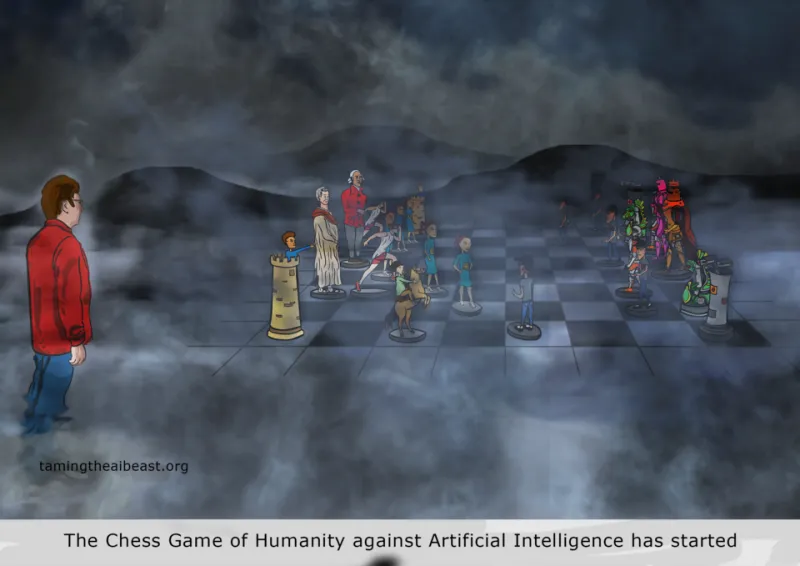
Photo: tamingtheaibeast.org, CC BY-SA 4.0, via Wikimedia Commons
You respawn for the fifth time in a row. The enemy flanked you again — differently than before, from an angle you hadn't seen coming. You swear the game is learning your moves. Spoiler: it probably is.
Artificial intelligence has been part of gaming since the blinking ghosts of Pac-Man chased you around a maze, but what's happening in games right now is a whole different animal. Modern machine learning isn't just scripted behavior with a few random variables thrown in. It's adaptive, reactive, and — in some cases — genuinely surprising. And it's showing up in everything from big-budget console titles to the casual browser games you knock out on your lunch break.
The Old Way vs. The New Way
For decades, game developers built enemies and opponents using something called finite state machines — basically a flowchart of "if the player does X, do Y." It worked fine, but experienced players learned to exploit the patterns. Speedrunners built entire careers around it.
Machine learning flips that script. Instead of following a fixed decision tree, AI opponents trained with modern techniques can observe player behavior over time and adjust. Think of it like playing chess against someone who's been studying your game film. The longer you play, the harder it becomes to surprise them.
Games like Halo 2 were early movers — its Elites were famously praised for dodging grenades and flanking players in ways that felt almost human. But that was still largely hand-crafted behavior. What's happening today goes further.
Adaptive Difficulty Done Right
One of the most player-friendly applications of AI in gaming is dynamic difficulty adjustment, or DDA. The concept is simple: the game watches how you're doing and subtly tweaks the challenge to keep you in what game designers call the "flow state" — that sweet spot between bored and frustrated.
Resident Evil 4 was doing a version of this back in 2005, quietly reducing enemy health if players were struggling. But modern implementations are far more sophisticated. Left 4 Dead's "Director" AI became legendary for monitoring player stress levels — based on health, ammo, and time since last encounter — and then dynamically spawning enemies or relief accordingly. The result felt cinematic and tense in a way that scripted encounters never quite managed.
More recently, games like Marvel's Spider-Man 2 and several major sports titles use machine learning models to calibrate opponent behavior based on your actual skill metrics, not just a difficulty slider you set at the start. You don't have to dig through settings menus. The game just... figures it out.
NPCs That Actually Feel Alive
Nothing breaks immersion faster than an NPC doing something obviously dumb — a guard who can't see you standing three feet away, a shopkeeper who repeats the same two lines forever. AI is finally starting to fix that.
NVIDIA's ACE (Avatar Cloud Engine) technology is one of the most talked-about developments in this space. It uses large language models to give NPCs the ability to hold genuine, context-aware conversations with players — not from a menu of preset responses, but in real time. Demos have shown bartenders and side characters responding to questions they were never explicitly programmed to answer.
Bethesda and other open-world developers have been experimenting with AI-driven NPC schedules and memory systems, where characters remember your past interactions and adjust their behavior accordingly. Imagine a vendor who's still a little cold toward you because you stole from his shop two hours ago. That kind of persistent, reactive world-building used to require an army of writers. AI is starting to make it scalable.
Personalized Content: The Game That Knows You
Beyond opponents and characters, AI is changing what content you actually see. Procedural generation has been around forever — Minecraft and No Man's Sky built entire universes out of algorithmic randomness — but machine learning adds a personalization layer that procedural generation alone can't deliver.
Streaming platforms and recommendation engines have been doing this for years (your Netflix queue is basically a mirror of your soul at this point). Games are catching up. Platforms like Xbox and PlayStation now use player behavior data to surface game recommendations, adjust storefront layouts, and even personalize tutorial content based on how quickly you grasp mechanics.
Some mobile and casual games go even further, using AI to analyze session length, drop-off points, and engagement patterns to dynamically adjust what content gets served next. It sounds a little surveillance-y, but the practical effect for players is a smoother, more satisfying experience with less friction.
What's Coming Next
The next frontier is generative AI woven directly into gameplay — not just in menus or behind-the-scenes systems, but as a core mechanic. Imagine a dungeon master AI that creates unique quest narratives on the fly based on your character's history. Or a co-op partner NPC that develops a genuine playstyle over dozens of sessions with you.
Companies like Ubisoft have already been public about experimenting with AI-generated dialogue and mission structures. Indie developers, with less bureaucracy and more creative freedom, are moving even faster. Games like AI Dungeon offered an early (if rough) glimpse of what fully generative narrative gaming could look like.
There are real conversations to be had about what this means for game writers, artists, and designers — those are valid concerns worth watching. But from a pure player experience standpoint, the trajectory is toward games that feel less like products and more like living, responsive systems built around you specifically.
The Takeaway for Everyday Players
You don't need to understand gradient descent or neural networks to appreciate what's happening here. The practical upshot is simple: games are getting better at meeting you where you are. Whether you're a hardcore grinder or someone who just wants to unwind for 20 minutes after work, the AI running under the hood is increasingly designed to make that experience feel just right.
Next time an enemy catches you off guard with a move you didn't see coming, or a game somehow nails the exact pacing you needed without you touching a single setting — that's not magic. That's machine learning doing its job. And honestly? It's pretty cool.